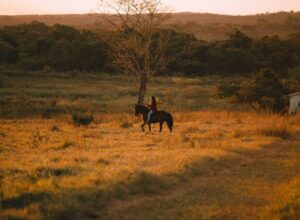
Horse riding safaris in Kenya let you move through wildlife country the way people did before safari vehicles: quietly, slowly and at eye level with giraffe and zebra. The best places to ride are the private conservancies of Laikipia, the Masai Mara and the Chyulu Hills. Most wildlife rides suit intermediate riders, and the best months are June to October and January to February.
Because there is no engine, many animals simply carry on grazing as you pass. As a result, a ride often feels more personal than a game drive, and you can reach hills and valleys where vehicles cannot go.
| Question | Short answer |
|---|---|
| Best regions | Laikipia Plateau, Masai Mara conservancies, Chyulu Hills |
| Wildlife you may ride among | Giraffe, zebra, eland, wildebeest and buffalo; rhino from a safe distance in Laikipia |
| Rider level | Mostly intermediate: you should control a horse at walk, trot and canter |
| Beginners | Short, gentle rides near the stables at some lodges |
| Age and weight limits | Vary by stable; at ol Donyo Lodge, riders must be 12+ and under 95 kg |
| Ride length | 2 to 4 hours a day at lodges; up to 6 hours a day on multi-day rides |
| Safari styles | Lodge-based daily rides, or mobile rides moving between camps |
| Best time | June to October and January to February (dry seasons) |
| Combine with | Game drives, walking safaris, rhino tracking or a beach stay |
Horseback riding safaris in Kenya offer a completely different view of the bush. Unlike a vehicle safari, where you watch from behind a window, riding puts you in the landscape itself. You hear the hooves, smell the grass and feel the wind off the plains.
For many riders, the bond with the horse is part of the magic. Prey animals such as zebra and wildebeest often see a horse as just another grazer. Consequently, you can sometimes get closer to them than you would by car, always guided by an expert who knows when to hold back.

Kenya’s private and community conservancies are the heart of riding safaris. Unlike national parks, they allow activities on horseback, and guest fees help protect wildlife and support local landowners. These are the best places to saddle up.
The Laikipia Plateau is Kenya’s leading riding region. Its private ranches and conservancies, including Solio Ranch, Borana Conservancy and Mugie Conservancy, protect elephants, rhinos, cheetahs and big herds of plains game.
Borana in particular has a strong riding tradition. It has hosted multi-day horseback safaris that combine lodge nights with fly-camping, with riders spending around six hours a day in the saddle. Meanwhile, Mount Kenya often rises on the horizon as you ride across open grassland.
Lewa Wildlife Conservancy sits on the northern foothills of Mount Kenya. It is one of Kenya’s most important rhino sanctuaries, protecting both black and white rhinos, as well as the endangered Grevy’s zebra.
Riding here takes you through bushland and open savannah with wide views of Mount Kenya. Morning and late-afternoon rides are best, when the light is soft and the animals are most active.
For a remote, luxurious ride, head to ol Donyo Lodge in the Chyulu Hills of southern Kenya, formerly known as Ol Donyo Wuas. Rides cross the private plains of Mbirikani Ranch, between Amboseli and Tsavo, with Kilimanjaro often visible in the distance.
The lodge offers daily rides of two to four hours. Most are for confident riders, though there are gentler rides in the foothills for less experienced guests. Riders must be at least 12, weigh under 95 kg and complete a short riding assessment first.
The Masai Mara National Reserve is famous for big cats and the Great Migration. However, horse riding takes place in the private conservancies around it, such as Naboisho, Olare Motorogi and Mara North.
These conservancies cap visitor numbers, so rides feel peaceful and unhurried. You may pass herds of zebra, topi and wildebeest, and in season you may even ride along the edges of the Migration herds.
Ol Pejeta Conservancy in central Kenya has offered horseback rides, including short rides on open plains near the stables that suit beginners. It is a good choice if you want a first taste of riding on a wider safari.
Ol Pejeta is also home to Najin and Fatu, the last two northern white rhinos on Earth. They live under 24-hour protection, so you will visit them by vehicle or on foot rather than on horseback.
After a few days in the saddle, northern Kenya makes a superb contrast. These two experiences are on foot rather than horseback, but they pair beautifully with a Laikipia ride.
Sera Community Conservancy was the first community in Africa to own and run a black rhino sanctuary. Here, you can track rhinos on foot with community rangers, through semi-arid country that is also home to reticulated giraffe and Grevy’s zebra.
Kitich Camp sits in a forested valley in the Mathews Range of northern Kenya. Instead of open savannah, you explore forest trails and natural pools on guided walks with Samburu trackers.
Forest elephants, leopards and De Brazza’s monkeys live in the valley. In addition, you can visit the Singing Wells, where Samburu herders sing to their cattle as they draw water.
The best time for horse riding safaris in Kenya is during the dry seasons, from June to October and from January to February. The ground is firm, the grass is shorter and wildlife gathers near water, so animals are easier to find.
In the Masai Mara, the Great Migration usually peaks between July and October. By contrast, the long rains from April to May can make the going heavy, and some stables limit or pause rides. November’s short rains are lighter, so it can be a quieter, good-value time to ride.
A riding safari turns watching wildlife into a journey. Each day, you cover new ground, cross rivers and climb ridges for views that few visitors ever see.
Furthermore, horseback riding safaris in Kenya reach places vehicles cannot, from rocky hillsides to quiet valleys. The result is a more authentic encounter with the wild, and one you will remember long after you leave.
For most wildlife rides, yes. You should be comfortable at walk, trot and canter over uneven ground. However, some places, such as ol Donyo Lodge and Ol Pejeta, offer short, gentle rides for less experienced riders.
Rides are led by experienced riding guides who know the land and its animals. They keep a safe distance from predators, elephants and buffalo, and they choose routes to suit the group’s ability.
Yes, and it varies by stable. For example, ol Donyo Lodge asks riders to be at least 12 and under 95 kg. Multi-day rides often set a higher minimum age, such as 15.
Wear neutral colours such as khaki, olive or brown, plus long breeches or trousers and riding boots or half chaps. Bring a riding helmet if you have one, along with sunscreen and a light jacket for cool mornings.
Yes, and most guests do. A typical trip pairs two or three days of riding in Laikipia or the Chyulu Hills with game drives in the Masai Mara.
Whether you dream of riding beside Mount Kenya, across the Chyulu plains or through the Mara conservancies, we can plan the right ride for your ability. Tell us your riding experience, dates and travel plans, and we will match you with the right stables and lodges.
Wild Sights Safaris is licensed by Kenya’s Tourism Regulatory Authority (licence no. TRA1/22/C01/76306). Every lodge and stable we recommend is vetted by our team.
Horse riding in Kenya offers an unforgettable way to connect with nature and wildlife. From the Maasai Mara to Laikipia, the country’s open landscapes are made for exploring on horseback. So saddle up and get ready for the adventure of a lifetime.
WhatsApp us